
In This Story
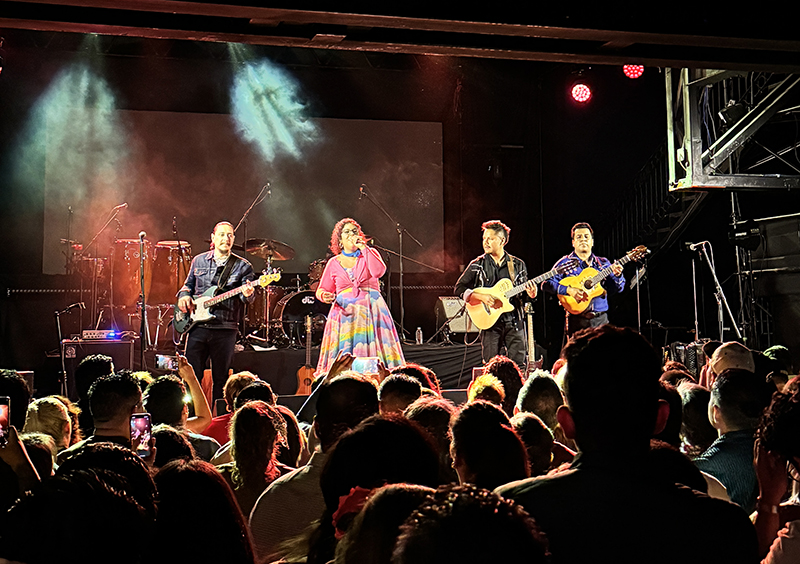
Grammy Award-winning band La Santa Cecilia, known for its seamless blend of Latin culture, rock, and world music, led a timely week of events as a Mason Artist-in-Residence, exploring art and advocacy leading up to its November 15 concert at the Center for the Arts. Working closely with students, faculty, staff, and community members from across George Mason University’s campus and around northern Virginia, band members engaged in personal and powerful discussions and musical performances, as the threat of detention and deportation by the Department of Homeland Security’s Immigration and Customs Enforcement (ICE) looms for undocumented individuals in the U.S. The band first rose to fame with its song El Hielo, which translates as "ice," and has been described as an anthem for immigration reform, telling stories based on the real lives of undocumented individuals.
The band’s roots trace back to busking on the oldest street in Los Angeles, Olvera Street, home to a bustling Mexican marketplace. As a teenager, Marisoul Hernández sang and passed the hat outside near the shop her father owned, and notes that he was ultimately the one who suggested she try performing something together with the accordion/requinto player Jose “Pepe” Carlos, who also busked down the street with his little brother. Eventually adding percussionist Miguel “Oso” Ramirez and bassist Alex Bendaña to the mix, they formed the band La Santa Cecilia, drawing its name from the Catholic saint of musicians. The group has become the voice of a new bicultural generation in the United States, and NPR has described their performances—modern yet always drawing upon and experimenting with their Latin American influences and Mexican heritage—as “flawless.”

Upon the band’s arrival Nov. 12 at the Center for the Arts, the four members joined staff and students for a celebratory welcome lunch, then headed to Fairfax County Public School Laurel Ridge Elementary, to lead two energetic assemblies of music and conversation with approximately 600 sixth-grade students as part of the school’s Spanish Immersion Program. Center for the Arts Programming Assistant Esteban Marmolejo-Suarez said, “The students especially enjoyed learning about the band’s participation in soundtracks for hit animated movies including “Un Mundo Raro” from Coco and “The Apology Song” from The Book of Life,” directed by Mexican director Guillermo del Toro. Pepe Carlos even shared his accordion with teachers and students, allowing them to try out the instrument. One sixth-grader dubbed the whole experience “chef’s kiss.”

That evening, back at the Center for the Arts for Empathy in Action: Art and Advocacy, a co-presentation with George Mason University’s Institute for Immigration Research and Folklore Program, band members talked with Professor Lisa Gilman, Director of the Institute for Immigration Research and Professor of Folklore and English, and played some tunes. Lead singer and jarana player Hernández introduced herself as “the singer, the screamer, the crier” of the group. A devoted Beatles fan who noted during the conversation that she plays “Here Comes the Sun” every morning to wake up her daughter, Hernández described how she was driving in California past strawberry fields worked by immigrants, when she realized how strongly the Beatles’s iconic song “Strawberry Fields Forever” resonated for her. She connected with John Lennon’s nostalgic memories of his childhood and feelings of outsiderness, translating the experience into the band’s heartfelt Spanglish cover of the song, which they performed in a moving rendition for the audience at several of the residency events.
Percussionist Ramirez, who performed on cajon at the residency events, also recounted how the band performed a show in L.A. on the same day the neighborhood had been devastated by an ICE raid that morning, with tears flowing freely in the audience, as well as from the performers onstage. As part of the Q&A following the presentation, a DC resident attending thanked the band for creating a safe space to be able to talk about immigration issues, which she said she felt she couldn’t speak freely about at her workplace.

The next day on Nov. 13, the band gave an Artists in Conversation event, co-presented by the City of Fairfax and the Center for the Arts at George Mason University at the Sherwood Community Center in Fairfax. Talking with moderator George Washington University Associate Professor of Latin American and Latinx Studies Manuel Cuellar, Pepe Carlos (originally from Oaxaca, Mexico) described how he had been undocumented in the U.S. for nearly 30 years, and could not initially sign a record contract when the band was picked up by Universal, or go on the international tour.

During the question and answer with the audience, an attendee poignantly thanked the band for sharing some of the traditional music that she had learned to love growing up with her father, who had recently passed away. Miguel and Marisoul responded tenderly, describing how they and Alex had lost their fathers all within six months of each other, and that the music they grew up provided a way they could maintain their close connections with them.
Vic Adebusola, College of Visual and Performing Arts Assistant Director of Programming and Engagement, noted that the band created a rare intimate bond with each audience it encountered during the residency. “They were able to go into all these different spaces and connect deeply with each group, in a beautiful way that is difficult to achieve.”

During the residency, La Santa Cecilia also worked closely with George Mason Dewberry School of Music students and faculty, including visits to the “Popular Music in America” class, taught by Professor Carrie Ann Delaney; the “Music History in Society III” class, taught by Professor Gregory Robinson (pictured above); and a roundtable discussion about navigating the music industry as Latine musicians with students (pictured below).

On the evening of Nov. 14 during Telling Our Stories: A Conversation with Mason Artist-in-Residence La Santa Cecilia, the members of La Santa Cecilia discussed their backgrounds with student leader Valentina O’Connor of UndocuMason, which works both internally and externally to institutionalize support and build community for undocumented students. The students even brought pupusas to share with the band and the members of the public in the audience.

For the culminating concert on Nov. 15, Professor Greg Robinson, Director of Ethnomusicology at Mason’s Dewberry School of Music, led another pre-performance discussion with the band members. Adebusola delightfully noted that after the conversation ended and right before the concert began, Robinson grabbed his accordion that he had learned to play in Chile, and jammed backstage with Pepe Carlos.
The performance onstage at the Center for the Arts Concert Hall, with an enthusiastic audience including staffers from the Mexican Cultural Institute, ended with the audience rising to its feet for a dance party, which continued out into the lobby afterwards with George Mason University’s Latin dance club Azúcar and host DJ Gustavo.

The Mason Artist-in-Residence program is supported in part by the Wendy Frieman and David Johnson Fund.
Launched during the 2019–20 season through George Mason University’s College of Visual and Performing Arts, the Mason Artist-in-Residence program connects artists appearing at the Center for the Arts and its sister-venue the Hylton Performing Arts Center with on- and off-campus communities. Artists engaged at the Center for the Arts have included Maria Schneider, A.I.M by Kyle Abraham, Indigenous Enterprise, Sphinx Virtuosi, Nrityagram Dance Ensemble, Third Coast Percussion, Camille A. Brown and Dancers, Small Island Big Song, Ballet Hispánico, the Silkroad Ensemble, Versa-Style Street Dance Company, Papermoon Puppet Theatre, and Limón Dance Company. The next Mason Artist-in-Residence at the Center for the Arts is the Grammy Award-winning Silkroad Ensemble, returning in March 2026 for its fourth consecutive year in residence.